
Platforms and Websites

Platforms & Websites

Your corporate website, customer portal, or digital platform is often the first point of contact with your audiences. It shapes first impressions, strengthens your brand, supports sales and recruitment, and helps generate leads and sales.

We design and develop corporate websites, content and story hubs, applications, landing pages, and digital services that combine strategic thinking, user-centred design, and scalable technology. Our focus is on creating platforms that are easy to use, support your business goals, and deliver long-term value.

  • UX/UI Design Systems
  • Prototyping
  • Platform Architecture
  • Platform Development
  • eCommerce
  • API & Tool Orchestration
  • Personalisation
  • Extranets
  • Data & Analytics Integration

Selected clients who trust us to develop their platforms

Our approach combines strategy, design, and technology throughout every stage of a project, using proven methods and tools to create consistent, user-centred digital experiences.

1. Scoping, analysis, audit & discovery

We start by defining the project’s scope and objectives. This includes reviewing the current situation, competitors, business goals, the role of the website, and relevant KPIs. Based on these insights, we outline and discuss initial solution options.

2. Strategy & design: UX and information architecture

Good UX and information architecture reduce friction, improve conversion rates, and lower support costs. Based on our analysis, we develop detailed wireframes and a user-centred information architecture. Through an iterative design process, we shape the website around its functionality, visual design, and user behaviour.

3. Strategy & design: UI, web design and content

“Design without content is decoration.” Content and design are closely connected and equally important to a website’s success. We explore initial visual directions and develop them into a consistent design system, together with the key content elements needed for the project.

4. Strategy & design: technical architecture and requirements

Clear technical planning and well-defined requirements are essential for managing project scope, risks, and costs. We define the technical architecture and functional requirements to create a reliable foundation for development and implementation.

5. Build, development & implementation

Based on the approved design and functional requirements, we begin technical development and content production. Features and integrations are implemented in agreed development stages, with continuous testing to ensure quality and functionality throughout the process.

6. Launch, maintenance & optimisation

A successful launch is followed by continuous maintenance and optimisation to ensure long-term performance and quality. Regular reporting against agreed KPIs helps us assess how the website and its services perform, identify areas for improvement, and make informed decisions about further development.

Platform-agnostic. Technology-neutral. Built around your needs. Some of the technologies we work with:

Many B2B websites struggle not because of their design, but because of poor structure, unclear content, inefficient processes, outdated technology, or a lack of measurable results.

These examples highlight common challenges and show how we help businesses identify problems and implement practical solutions:

Our approach:
We analyse key entry pages, calls to action, forms, and lead routing to identify conversion barriers. We then improve content, landing pages, and conversion paths with clearer offers, relevant proof points, and better lead qualification;  turning your website into a more effective sales channel.

Our approach:
We restructure websites around user needs, key tasks, and search intent. Using analytics, search data, and user interviews, we develop intuitive information architectures and improve navigation through clearer labels, cross-links, filters, and search functionality.

Our approach:
We simplify content management by improving the CMS, developing reusable content components, and establishing clear editorial processes. This allows teams to create and publish content quickly and confidently, without relying on developers for every new landing page or update.

Our approach:
We audit the existing CMS, including content models, templates, user roles, plugins, and technical debt. Based on the findings, we define a clearer architecture with standardised components, consistent publishing rules, and fewer exceptions – making the platform easier to maintain, more stable, and more cost-efficient.

Our approach:
We map existing systems and integrations, starting with the most relevant business use cases. We then define a phased integration plan connecting product data (PIM), CRM, marketing automation, and digital assets (DAM) with your website – including clear data ownership and interface requirements.

Our approach:
We establish reliable, privacy-compliant tracking with clear event definitions, consent management, tagging standards, and quality assurance. We also define business-focused KPIs – from leads and pipeline contribution to service efficiency and recruitment – and connect website, campaign, and CRM data in dashboards that help teams measure performance and make informed decisions.

Let’s talk about your next digital project.

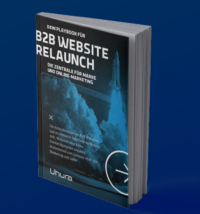
Our playbook for a successful B2B website relaunch

The B2B Website Relaunch Playbook

A practical guide to planning a successful B2B website relaunch. Structured into six key phases, with checklists and actionable to-dos for every step.

SELECTED PLATFORM & WEBSITE CASES